XT60 vs XT60i: A Comprehensive Professional Comparison with Practical Examples & Tabular Analysis
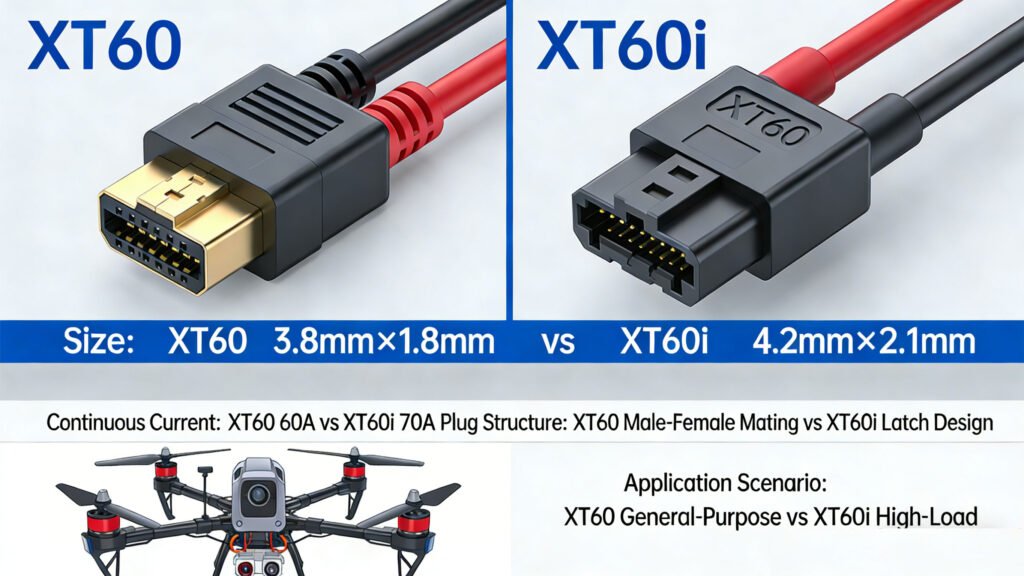
In the field of high-power electrical connections—encompassing RC models, commercial drones, portable solar power stations, and light electric vehicles—XT-series connectors are revered for their exceptional reliability and power-handling capabilities. The XT60 and its intelligent upgrade, the XT60i, are two of the most widely used models, yet their distinctions and ideal use cases often cause confusion among professionals and enthusiasts alike. This revised analysis integrates real-world application examples, detailed technical specifications, connector design insights, XT60-to-XT60i adapter compatibility, and a clear tabular comparison of core differences, tailored to help European and American users make precise component selections.
1. XT60 vs XT60i: Core Specifications & RC Performance
XT60 and XT60i share foundational specs for high-power RC use, but key differences tailor them to distinct needs. Below is a concise breakdown of critical parameters, paired with common European and American RC scenarios:
Current & Voltage Ratings: Both support 60A continuous and 100A peak current (5-10 second bursts)—ideal for 1/8-scale RC buggies (American off-road races) with 4000kV motors (drawing 45-55A). Their 500V DC rating also works for 48V Li-ion packs in European portable solar generators for off-grid RC setups.
Material & Flame-Retardant Performance: Gold-plated brass contacts minimize resistance and corrosion (vital for marine RC boats). Housings use UL94 V0 flame-retardant nylon (prevents LiPo fire spread) and withstand -20°C to 120°C—suitable for Nordic winter RC snowmobiles and Arizona drone charging stations.
Dimensions & Compatibility: Both share a 21.5mm×16mm×8mm footprint, fitting 5-inch FPV drones (European races) and 1/10-scale RC car packs. Unlike XT60H (23.8mm×20.0mm male housing), they offer universal RC battery fitment, enabling seamless retrofits.
XT60i’s Unique Intelligent Specs: The 4-pin design (2 power + 2 signal) adds telemetry, transmitting real-time LiPo SoC and temperature. This benefits California agricultural drones (preventing mid-flight failures) and European industrial RC tools (alerting to low power).
2. XT60 vs XT60i: Connector Design, Safety & Functionality
Safety and usability define XT60/XT60i designs, with XT60i enhancing XT60’s reliability for professional RC scenarios. Here’s a streamlined comparison:
XT60: Hobbyist-Focused Simplicity: Its polarized 2-pin design prevents reverse polarity (a top LiPo fire cause), ideal for beginner RC planes (European kits) and budget FPV drones. 180° outlet welding and a robust lock ensure stability in high-vibration American RC drag cars. UL94 V0 flame retardancy and low cost make it a hobbyist staple.
XT60i: Professional-Grade Safety & Intelligence: Building on polarization, it adds automatic reverse-polarity power cutoff (protecting €5k European cinematography drones). IP67 waterproofing suits Mediterranean RC yachts and American coastal drones. Integrated telemetry eliminates extra wiring for smart LiPo setups.
3. XT60 vs XT60i: Compatibility via XT60-to-XT60i Adapters
Adapters bridge XT60 legacy systems and XT60i upgrades, preserving RC safety and performance. Below is a simplified overview for European and American users:
Adapter Design & RC Suitability: High-quality adapters use 12AWG tinned copper wire (UL2468 certified) and XLPE insulation (-40°C to 120°C), matching UL94 V0 flame retardancy. 180° welding prevents loose connections in intense RC maneuvers, from Canadian winter snowmobiles to Florida drone races.
Key Features & Use Cases: Adapters retain XT60i’s anti-reverse protection, letting European farms connect XT60 batteries to XT60i solar generators. Plug-and-play installation benefits hobbyists upgrading drones, while IP67 waterproof variants suit Portuguese coastal monitoring projects.
Value for Mixed Fleets: They avoid full system overhauls in American factories and let European FPV racers gradually upgrade from XT60 batteries to XT60i controllers, balancing cost and performance.
4. XT60 vs XT60i: Core Differences (Tabular Comparison) & Selection Guidelines
To simplify comparison, the table below summarizes key differences between XT60 and XT60i, including specs, design, functionality, and ideal applications. Examples specific to European and American markets are included to guide selection:
| Comparison Dimension | XT60 | XT60i | Typical RC & Hobby Applications (Europe & America) |
|---|---|---|---|
| Pin Configuration | 2-pin (power only) | 4-pin (2 power + 2 signal) | XT60: Entry-level FPV drones (European racing leagues), 1/10-scale RC cars (U.S. hobby shops). XT60i: Professional agricultural drones (California), smart LiPo batteries for cinematic UAVs (German film crews). |
| Reverse Polarity Protection | Polarized design (passive prevention, UL94 V0 housing) | Polarized design + automatic power cutoff (active protection, UL94 V0 housing) | XT60: Beginner RC planes (European hobby kits), budget LiPo battery packs. XT60i: High-end cinematography drones (European film sets), industrial-grade RC surveying equipment (U.S. construction sites). |
| Telemetry Capability | None | Real-time data (SoC, temperature, voltage for LiPo monitoring) | XT60: Basic RC boats (U.S. lake recreation), entry-level RC trucks. XT60i: Long-range FPV drones (Portuguese coastal races), solar-powered RC surveillance units (Arizona). |
| Flame-Retardant & Installation | UL94 V0 nylon, 180° outlet welding, IP40 (dust-resistant) | UL94 V0 nylon, 180° outlet welding, IP67 (waterproof) | XT60: Indoor RC workshops (European hobby centers), dry-environment LiPo setups. XT60i: Marine RC yachts (Mediterranean racing), outdoor drone charging stations (Florida wetlands). |
| Cost & Complexity | Lower cost, simple design (ideal for hobbyists) | Higher cost, intelligent features (ideal for professionals) | XT60: Mass-market RC toys (U.S. big-box stores), DIY drone builds. XT60i: Commercial UAVs (European surveying firms), industrial automation RC tools (U.S. factories). |
| Retrofit Compatibility | Universal with XT-series adapters, fits standard RC battery compartments | Backward-compatible via adapters, same footprint as XT60 | XT60: Upgrading vintage RC trucks (U.S. collectors), retrofitting budget drones. XT60i: Retrofitting existing professional drones (European UAV services) with smart monitoring. |
Choose XT60 if you’re building entry-level RC models, budget FPV drones, or basic LiPo battery setups—its simplicity, UL94 V0 flame retardancy, and low cost make it perfect for hobbyists. Opt for XT60i if your application demands LiPo safety upgrades (active anti-reverse for expensive drones), real-time telemetry (long-range flights), or waterproofing (outdoor/marine RC use). For mixed fleets (e.g., upgrading from XT60 to XT60i without replacing all batteries), high-quality adapters preserve flame-retardant and current-handling performance, avoiding safety compromises.
Conclusion
The XT60 and XT60i stand as pillars of high-power RC connectors, each tailored to distinct needs in European and American hobbyist and professional markets. The XT60 excels as a reliable, flame-retardant workhorse for entry-level to mid-tier RC setups, where simplicity and cost-efficiency are paramount. The XT60i elevates performance with intelligent telemetry, active safety features, and waterproofing—critical for high-value drones, industrial RC tools, and extreme-environment use. By integrating RC-specific details (flame retardancy, welding design, LiPo compatibility) and clear tabular comparison, this analysis equips users to select the ideal connector for their setup, whether it’s a weekend RC race in Texas, a cinematic drone shoot in Spain, or a long-range FPV flight in Portugal.